The following short (2:00 minute + 33 second ad for the SMITHSONIAN) video clip is of the 1941 attack on Pearl Harbor which began the overt entry of the United States in WWII. The two videos in this story may be seen without going to YouTube, because they are “embedded” right here – on this page. You might enjoy seeing them more impressively in FULL-SCREEN mode by clicking on the small ‘box’ in the lower right corner of each video.
Former US Marine Corps Pilot, long time FASF member and Officer of Flight 24 of the Daedalian Society, FASF Aviation Reporter, Jerry Dixon (L) sent this story to us:
Two Pearl Harbor myths that seem to have real staying power – even today.
1 – The U.S. was “lucky” that the aircraft carriers were not in Pearl Harbor on December 7th, 1941.
Not sure how this one got started but it’s been around as long as I can remember. The problem is, there was little to no chance that a US aircraft carrier would have been in Pearl Harbor in 1941.
It was rare to have one in port anytime . . . and no chance for two (2) to be there.
In 1941, the US had 7 CV (aircraft carriers), and of those, two were operating out of Pearl Harbor. However, Pearl Harbor was not their home port. San Diego, CA was.
So why was it “rare” to have a carrier “in Pearl Harbor”? Well, it was because Pearl Harbor in 1941 was not one of the top bases for the US Navy. It was in fact relatively small and shallow, compared to say, Puget Sound, San Diego, Oakland, or San Pedro. So when one of the pre-war carriers entered the harbor to refuel and restock stores, it created a lot of traffic problems and headaches. Because of this extra hassle, they got a carrier in and out as fast as possible. If either of the carriers needed a longer port stay, it would return to San Diego, not stay at Pearl Harbor.
Because of these traffic and space issues, the carriers were scheduled in and out to avoid having both needing to refuel at the same time. So the ships worked on a rotating schedule that effectively meant, only one need to visit at any given time, and in fact, both were gone the vast majority of the time.
Thus it was never the case that “both” carriers would have been at Pearl Harbor on December 7th. And it was highly unlikely on any given day that even a single carrier would be there. Thus even the Japanese knew it was highly unlikely they would find even a single carrier in the harbor when they decided to stage the attack.
It wasn’t “luck” it was very much against the odds that a carrier would have been in Pearl Harbor for an attack.
2 – The Japanese devised a very original and clever plan for how to attack Pearl Harbor, and they were inspired by the British attack on the Italian Navy.
The Japanese attack on Pearl Harbor followed a very meticulous plan, but it was not a Japanese or British plan. Ironically the attack plan that the Japanese were inspired by and followed closely was in fact created by and executed by a US Navy Admiral and the US Navy itself.
The first Pearl Harbor attack plan and subsequent attack occurred on February 7th, 1932, nine years prior to the Japanese attack. Rear Admiral Harry Yarnell, was assigned the command of the “aggressor” forces in the annual Pacific Fleet exercises in which mock attacks were planned on US facilities. Yarnell was assigned command of the aggressors who were to attack Pearl Harbor.
The standard approach in 1930 was for the aggressors to send their battleships forward supported by aircraft carriers, cruisers, and destroyers. And the battleships would slug it out.
But for this exercise, Yarnell one of the few believers in the power of naval aviation, decided to “not follow the script” as was custom. He took his fleet to sea but ordered his battleships and cruisers to remain out to sea and maneuver off the coast of California.
Yarnell then took his two aircraft carriers with the destroyers and entered a westerly moving storm hiding in it all the way to Hawaii. (in 1932 the U.S. had not yet develped weather and/or weather piercing RADAR). The storm shielded his ships from aircraft and he travelled in radio silence.
His plan called for his ships to emerge from the storm early on Sunday morning February 7th northwest of Oahu. From this position, Yarnell sent his aircraft east just past the island, had them hook around to the south and then to the west arriving with the sun behind them as they came in over Diamond Head and into their attack on the anchorage and airfields.
Yarnell had picked a Sunday because he expected to catch the fleet unprepared and napping on what was a “day off”.
Despite the Navy and Army knowing an exercise was in progress his plan worked perfectly. Using flower bags for bombs, the aggressors managed to completely disable the airfields and sink all the battleships in the harbor. The attack achieved complete surprise and was an overwhelming success. The umpires awarded the Yarnell forces a total victory and declared the attack completely successful. The ships were “sunk,” and “the airfield was completely disabled.”
Later, Army and Navy brass complained that Yarnell had “cheated” and it was “unfair” and “inappropriate” to have attacked on Sunday morning, so much so that the result was reversed. But while the Army and Navy brass were whining, the Japanese took note.
8 years and 10 months later the Japanese followed a storm to the Hawaiian Island, and on a Sunday morning, emerged from the storm to send their planes east of Oahu to attack out of the sun, against the airfields and harbor. The Japanese Imperial Navy followed Yarnell’s plan precisely – – – and, as did Yarnell almost 9 years earlier – they achieved complete and overwhelming success.
If any of you readers have other similar WWII myths – – – or similar stories to share, please let us know by commenting in the “LEAVE A REPLY” field at the bottom of this page.
Here is another film (just under 15 minutes long) from the infamous attack on Pearl Harbor, This short documentary tells the story of Harold & Eda Oberg, both of whom had just recently arrived on Oahu, where Harold, a US Army Air Corps Technical Sergeant, had been assigned to Hickam Army Airfield. When they awoke that fateful Sunday morning in their Apartment on 16th street, it was to the bedlam of roaring planes and exploding bombs and ships in the close-by Navy Port. Immediatedly, upon recognizing the Emperial Rising Sun insignia on a rapildy diving bomber, Harold donned his helmet and rushed off for his duty post at Hickam. Eda, thinking, after the first wave of planes had left, that the attack was over, grabbed their new 8mm cameral, which was already loaded with fresh color film, and began shooting. This is an extraordinary film, especially since it is in color, and a rare footage of that fateful day’s attack on the Harbor and Airfield by the Japanese.
Tag Archives: Daedalian Society
FLY LIKE A GIRL! USAF Academy Magazine Story about ‘FIRST’
Another coincidence: This time about our last post concerning USAF Fighter Pilot Captain Melaine “First” Valentin, the Daedalian Society’s Top Leadership awardee of the September 2022 314th Fighter Squadron Graduating Class at Holloman AFB, NM.
Considering the size of the USAF, as an amazing coincidence, almost simultaneously, just as we posted her story, the Air Force Academy‘s prestigious Quarterly Magazine for its Alumni Organization, CHECKPOINTS, also printed a parallel feature story about “First” Valentin.
Here, below, is the cover of that issue: (We found out about this coincidence from Col. Alan Fisher, an AF Academy graduate and regular reader of CHECKPOINTS, who excitedly informed your webmaster, that “FIRST” had also just been featured in a distinguished graduate story the same month she was awarded the top LEADER award in her graduating Fighter Class at Holloman. When the Academy CHECKPOINTS staff wrote the article, they didn’t know anything about Captain Valentin’s Leadership award ceremony – nor did we know about their story.
Cover of September 2022 CHECKPOINTS – photo of Cadet 3rd Class Lydia Cella in Combat Survival Training Program
Through the good efforts of two Air Force Academy fellow graduates and long-time FASF members, Alan Fisher and Wes Baker, we were led to the magazine’s Managing Editor, Jeff Holmquist, who gave us the OK to reprint their “First” story. Without further ado, here it is:
[TO VIEW THIS PDF COPY SIMPLY EITHER USE THE “+” SIGN IN THE TOOLBOX AT THE BOTTOM OF THE VIEW YOU SEE OR CLICK ON THE SMALL POPOUT ICON (
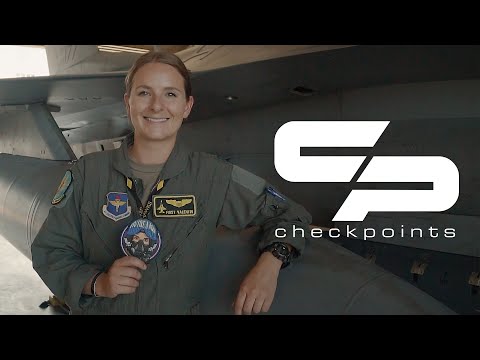
Now let’s look at a short (3:57) video of “First,” one also produced by “CHECKPOINTS” and get a look at how Captain Valentin uses her non-pilot-oriented artistic talents:
[NOTE: Suggest you click on the “Full Screen” mode button at the lower right of the video for the best high-resolution viewing experience.]
McGee Briefs Daedalians on New UTEP Aero Space Program
Dr. McGee (Left) is a Senior Research Associate at the NASA Center for Aerospace Exploration and Technology Research at the University of Texas at El Paso (UTEP).
Retired from the U.S. Air Force, Dr. McGee served as an F-16 pilot, including multiple tours and Mission Commander experience. He was a Command Pilot, a Standards and Evaluation Pilot, and spent four years as an instructor pilot in the F-16 division of the Air Force Fighter Weapons School. He is also a Daedalian.
At a recent Daedalian Society meeting at the El Paso Club in downtown El Paso, Dr. McGee, most recently with California’s famous RAND Corporation, helped bring the Daedalians up to speed on UTEP’s latest Aero-Space developments and future plans.
All the local Daedalians are former or current military aviators as well as FASF members. Dr. McGee educated the Daedalian Flight about the new UTEP Program.
He observed that the recently retired former U.S. Secretary of the Air Force, Heather Wilson, PhD, is the new UTEP President, and is, as well, an instrument rated general aviation pilot in her own right. Her father was a commercial pilot. Ms. Wilson graduated with honors from the USAF Academy and served as a U.S. Congresswoman from New Mexico. Her unique background with its focus on aviation might help explain why Dr. Wilson has such a deep personal interest in helping this innovative new space-oriented program become airborne.
To see any photos below in high resolution, simply click on them. Once on your new browser tab, another click will enlarge them to full size.
Before the meeting began, members and guests socialized. Here, L to R are: Mario Campos, Mike McGee, Jerry Dixon, Mark Pfluger, Charlie Overstreet, and, seated, Schelmo Rocha, assistant to Colonel Norman Rice
L to R Standing: Roger Springstead, Dr. McGee, Mario Campos, Jerry Dixon, Mark Pfluger, Charlie Overstreet, Josianna and Gerry Wingett – Seated: Mr. Rocha, Norman Rice and his daughter, Timbiya Rice
Dr. McGee, explains the new air space challenges presented by the explosion in the numbers of drones in the U.S.
Dr. McGee points out the serious air safety challenges posed by the fact that Airline Departures at Airports are well published in advance, presenting serious security threats from ill-intentioned drone operators.
Dr. McGee describes the additional aviation security threat posed by the ability of large numbers of airborne drones to be “swarmed” – creating virtual “clouds” of them in the air space.
Presentation ended, Flight Capt. Col. Campos presents Dr. McGee with a gift in thanks for his educational program
L to R: Dr. McGee posed by the Daedalian Seal with Vice Flight Capt. Ric Lambart and Flt. Captain Colonel Campos.
Below is Dr. McGee’s entire presentation, provided here because of its widespread implications for public safety in the new drone age. The video is 41:47 in length.
(This video of Mr. McGee’s presentation was removed on September 27, 2022, at his request.)
EAA and FASF’s Bob Dockendorf Inducted into Hall of Fame
Long time FASF and EAA Member, Bob Dockendorf poses proudly with his new Hall of Fame medal about his neck.
The FASF’s long-standing member from El Paso, Bob Dockendorf, has just been elected by the Board of Directors of the El Paso Aviation Association and the local Aviation Community to be inducted into the El Paso Aviation Hall of Fame. This past weekend celebrated this significant event with a special banquet, packed with area aviation celebrities and held at the Dona Ana Country International Jetport‘s famed War Eagles Air Museum (“WEAM”).
Most know Bob as the Executive Director of WEAM, but there is more you may not know:
Not just for his accomplishments as Director of WEAM, where, as its Executive Director, he has taken the historical facility to a new level of admirable excellence, but he was a key founder among the few local area aviators who started the highly successful new EAA chapter 1570 at the Dona Ana County International Jetport.
He also directed the start of the John and Betty MacGuire student Pilot scholarship as part of that same EAA 1570 project. This student contribution provides both an aircraft and flight instruction for young adults up to and including their first solo flight.
Those are but just a few of his aviation contributions to our local communities. Besides his personal membership in the FASF, Bob’s beloved WEAM is one of our proud Local Business Supporters, too.
Here is a quote from the official Aviation Hall of Fame Award plaque created in Bob’s Honor:
Even in his childhood days, Robert J. (Bob) Dockendorf had a passion for history,
aviation and museums. Born and educated in Milwaukee, Wisconsin, several job
promotions and opportunities eventually brought him, his wife Mary and their
family to El Paso, Texas.
He served proudly as the Squadron Leader of the Sun Country Squadron of the
Commemorative Air Force as well as an Officer of Chapter 1570 of the Experimental
Aircraft Association.
While completing his career as a property and casualty insurance broker, he served
in a professional advisory capacity to the newly formed War Eagles Air Museum. When
he retired from his successful insurance career, he was offered the opportunity and
challenge to serve as the War Eagles Air Museum’s Executive Director.
Being armed with aircraft, automobiles, memorabilia, and a deep desire to succeed, he
led the staff and volunteers at War Eagles to the accomplishment of the mission of the
museum, “To Educate and Encourage,” paying specific attention to youth. All those efforts
helped bring new life and energy to the Dona Ana County International Jetport at Santa
Teresa, New Mexico, adjacent to El Paso, Texas.
The following photographs were taken this past weekend at the ceremony and Banquet held in Bob’s honor, where Bob was inducted into the El Paso Texas Aviation Hall of Fame.
L to R: John Keithly, President of the EAA Chapter 1570 chats with Virg Hemphill, FASF Aviation News Scout and Volunteer Docent at WEAM. To Virg’s right in background, is FASF member and also Docent, Charlie Overstreet.
L to R: Docent Charlie Overstreet talking with Mario Campos, also a Docent at WEAM. Both are members of the FASF.
L to R: Ammber Valverde, Daedalian Aviation Scholarship winner, engaged in a lively discussion with her table mate, former El Paso, TX Mayor and renown local Aviator, Suzie Azar, who is also one of the FASF’s Advisors. Ammber is a Junior at the University of Texas El Paso (UTEP) and also a member of the New Mexico State University (NMSU) AFROTC. She plans to be an Air Force Pilot.
L to R: at the Daedalian Society Table is: Virg and Jenine Hemphill, Roger Nichols, Mayre Sue and Charlie Overstreet, and Mario and Judy Campos. All are active FASF members.
The El Paso CAP Table with two prior Hall of Fame awardees, Roland and Debbie Torres, along with their Cadet Honor Guard: From (R to L), Cadet Captain Hunter Spier in Dress Blue uniform, and C/CMSgt Jonathan Herl, C/Amn Eryal Martinez, C/MSgt Daniel Erives, , and C/A1C Vida Rote. This is the group of CAP Cadets who conducted the Flag Ceremonies at the opening and closing of the event.
Guest speaker and aviation enthusiast, “Doppler” Dave Spielman, long time Chief Meteorologist for the ABC Network TV Channel in El Paso, TX, KVIA.
Ammber Valverde with Daedalian Flight Captain, Roger Nichols. Roger’s flight is helping mentor Ms. Valverde
Amber poses with Mr. Dockendorf along with Laura Ditlevson, former winner of the EAA MacGuire Student Pilot Scholarship.
Ammber intently listens to former FASF Trustee and present FASF Advisor and Chair of the Dona Ana County International Jetport’s Board of Directors, Col. John Orton. An ex USAF JAG officer, John continues to fly his own Experimental Aircraft.